Bitcoin has a fixed supply of 21 million coins. That limit is hardcoded into the protocol – no central bank, government, or entity can create more BTC. On 9 March 2026, the network mined its 20 millionth coin at block 939,999. Less than 1 million BTC now remain. This guide covers how new bitcoin enters circulation, why the rate slows over time, and what happens when there's none left to mine.
How new bitcoin supply enters circulation
Miners create new bitcoin. They run specialised computers that process transactions and add them to the blockchain. Each time a miner adds a new block, the network rewards them with freshly minted BTC. That's the only way new bitcoin supply enters the market.
The Bitcoin network produces a new block roughly every 10 minutes. So at the current reward of 3.125 BTC per block, miners create about 450 new bitcoin per day.
But that rate halves roughly every four years – or every 210,000 blocks (an epoch). That’s the halving, and the table below shows the bitcoin supply halving schedule until 2032:
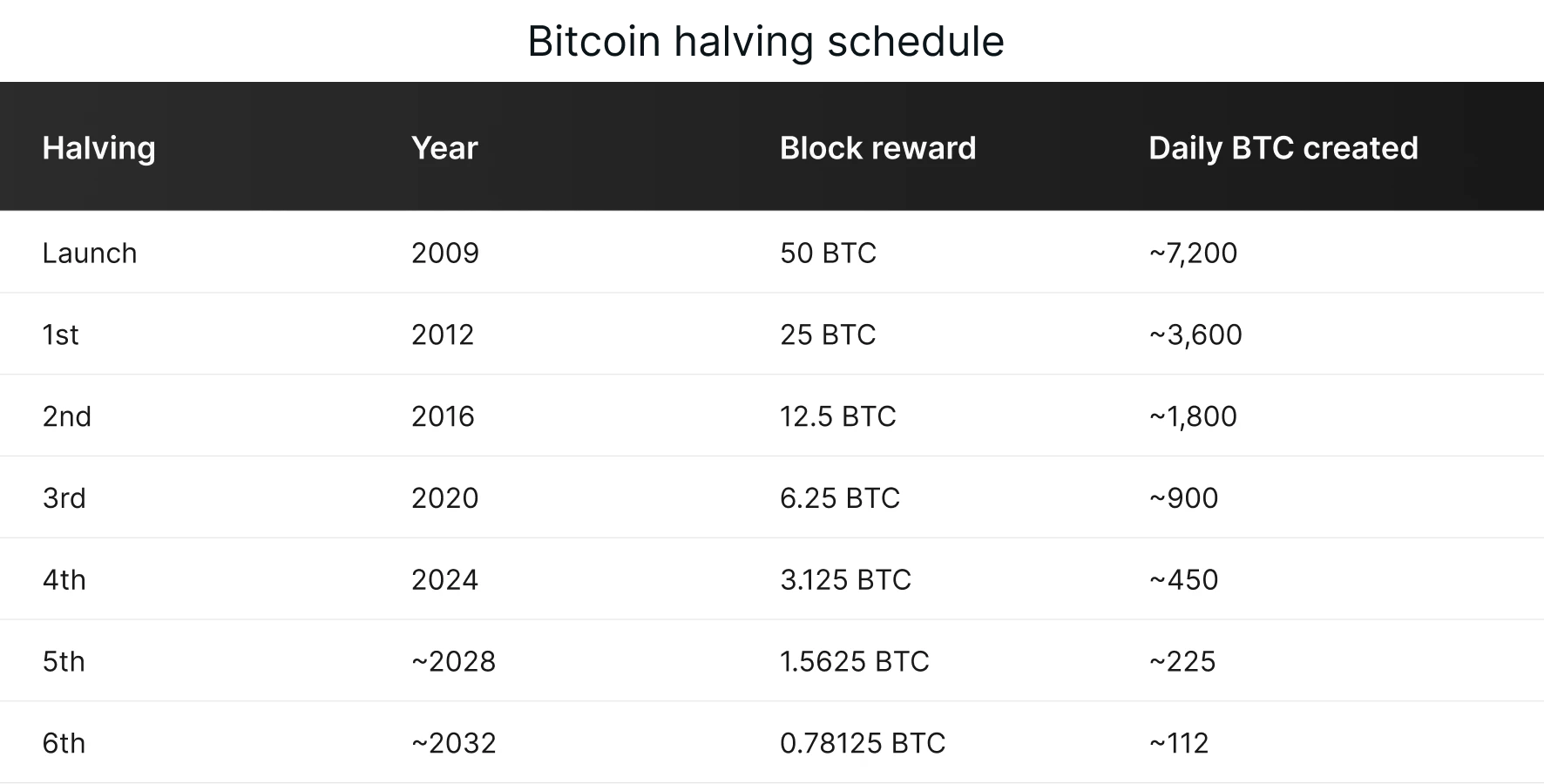
Each halving cuts the flow of new coins in half. That's why bitcoin's early years produced the most coins, and why the rate slows dramatically over time. The chart below shows what this should look like across bitcoin's full history.
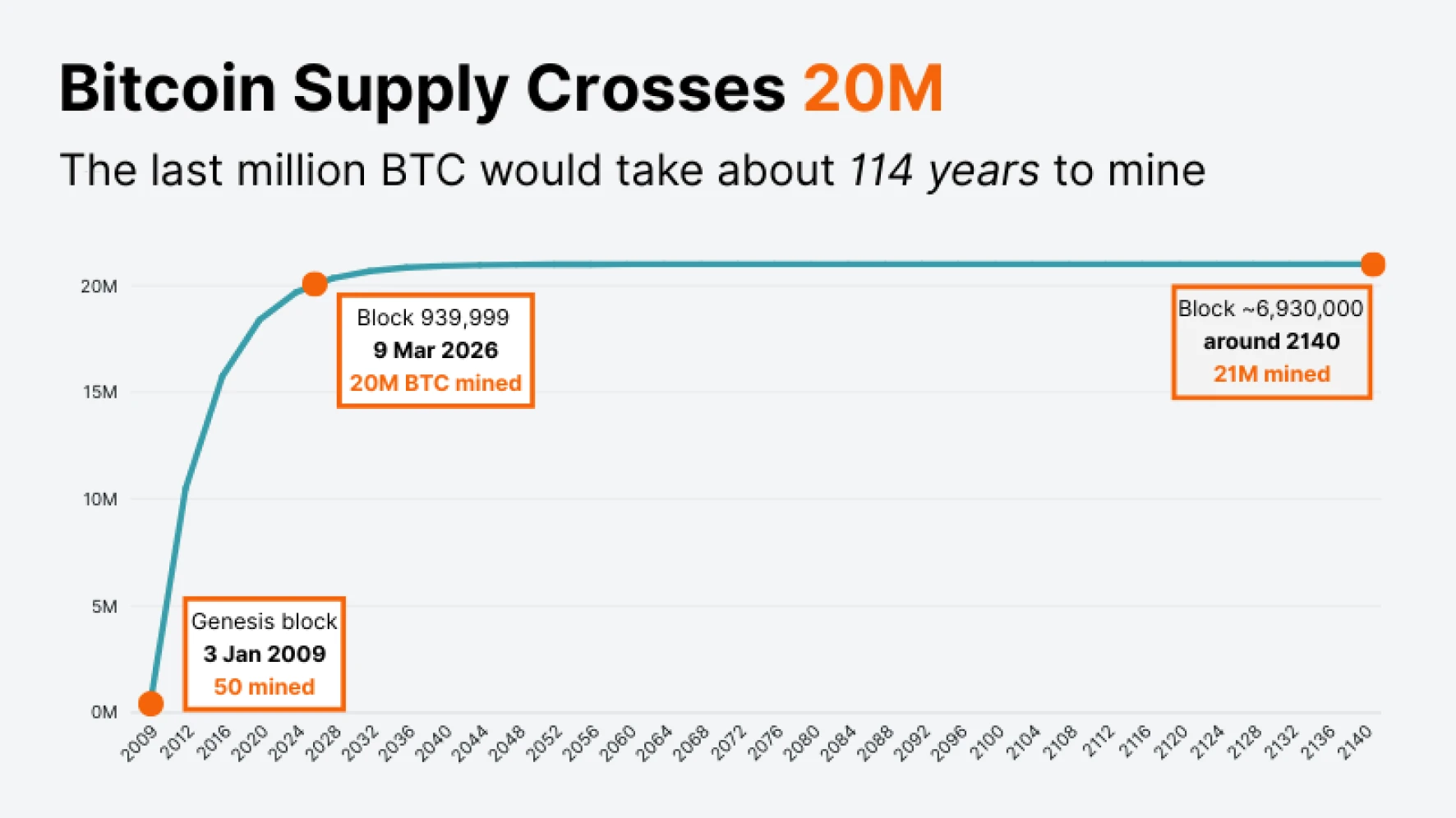 Source: TradingView | As of 11 March, 2026
It took 17 years to mine the first 20 million BTC. The last 1 million would take about 114 years. By the 2040s, miners will produce fewer than 30 BTC per day, according to the maths. By the 2060s, fewer than 2. The network will mint the final fraction of a coin around 2140. That’s when the block reward would fall to zero at roughly block 6,930,000.
Not all mined bitcoin is available, either. Chainalysis estimates that between 2.8 and 3.8 million BTC are permanently lost. Forgotten passwords, broken hard drives, and wallets with no known owner make the available supply lower than the mathematical supply.
What happens once all bitcoin is mined?
When the block reward reaches zero, miners won't be able to earn any new BTC. But they would still be able to collect transaction fees.
Every time someone sends bitcoin, they pay a small fee to the miner who includes that transaction in the current block. Today, those fees make up a small part of miner revenue versus the block reward. But as the reward shrinks with each halving, fees will need to take over.
Whether fees alone can sustain the network depends on how much people use it. If transaction volumes grow, fees could keep miners running. If they don't, some miners may shut down – which could affect network security.
But this doesn't happen overnight. The block reward halves slowly over the next century. Miners, developers, and the market have decades to adapt.
The 21 million cap is also what makes bitcoin different from fiat currencies. Central banks can print more money at any time. Bitcoin's supply schedule is public, predictable, and enforced by code. That's one reason some investors treat bitcoin as a potential store of value – though its price can still be volatile.
Leverage Shares offers 3X long and short Bitcoin ETPs, allowing investors to gain amplified exposure to daily moves in a regulated wrapper.
Key takeaways
Bitcoin has a fixed supply of 21 million coins. Over 95% have already been mined. The halving cuts the mining reward in half every four years, so the remaining coins will take about 114 years to produce.
An estimated 2–4 million BTC are permanently lost. That shrinks the circulating supply well below the 21 million cap.
Mathematically, the bitcoin block reward should reach zero sometime in the year 2140. At that point, miners would need to rely on BTC transaction fees for revenue. But this doesn't happen overnight. The reward halves slowly over decades. Miners have over a century to transition from block rewards to transaction fees.