Tokenized assets are barely a $33 billion market today, according to the RWA analytics platform.¹ But a recent Citi report sees that number reaching $5.5 trillion by 2030.² For context, that figure would equal over a third of all the money invested in US exchange-traded funds today.³ A large share of the tokenized asset market already runs on the Ethereum blockchain. Here are three reasons why, and what it could mean for ether (ETH).
What is tokenization?
Tokenization means turning ownership of a real asset into a token on a blockchain. The asset could be pretty much any traditional asset, like property, bonds, or stocks.
The token is your proof of legal asset ownership, and the blockchain keeps the record of who holds it. That record updates the moment a token changes hands.
A single asset can be divided into many tokens, with each token holding a small fraction of asset ownership. So someone can own a slice of a bond or a building, instead of the whole thing. This can improve liquidity among traditionally less liquid assets and give smaller investors better access.
Tokenized assets also trade differently from normal assets. They can move directly between buyers and sellers over the blockchain, with fewer intermediaries in between. That means they could trade around the clock – even on holidays and weekends. And with fewer middlemen involved, transactions can also be cheaper and faster.
Big institutional investors are already using tokenized assets on Ethereum. BlackRock launched its tokenized US Treasury fund, BUIDL, on Ethereum in 2024. JPMorgan and Fidelity have since launched tokenized funds there, too.⁴ ⁵ These firms could pick any blockchain, yet many launch on Ethereum first before branching out to other chains.
And here are the three reasons why…
Reason 1: Ethereum is likely the most secure smart contract blockchain
A smart contract is code that runs on a blockchain and carries out a deal automatically, with no middleman. For example: issuing shares, paying out interest automatically, or settling a trade when a payment lands.
Tokenized assets rely on smart contracts to do business securely, so the blockchain underneath must be secure too. Ethereum is arguably the most secure smart contract blockchain, with around 1.2 million validators to secure it.
Validators are the computers that check transactions and keep the network honest.⁶ Solana, for example, runs on roughly 800.⁷ Ethereum also has an 11-year track record of security. Its network has never fully shut down, while Solana's has experienced several outages.⁸
Reason 2: Ethereum already dominates DeFi
Decentralized finance (or DeFi) is a market of lending and trading apps built on smart contract blockchains. More than half of that market already runs on Ethereum, which currently holds around 53% of all the value locked inside DeFi.⁹ Where DeFi activity is today, tokenization activity could be tomorrow.
DeFi was the proof of concept. It showed that complex financial transactions can work onchain – directly between users. Tokenization is the next step, and likely a much bigger one. This time it's traditional finance moving onchain, not crypto-native money.
We believe DeFi and traditional finance are likely to merge over time, with tokenized assets at the centre of it. Right now, Ethereum is the most liquid option for that – it already dominates DeFi.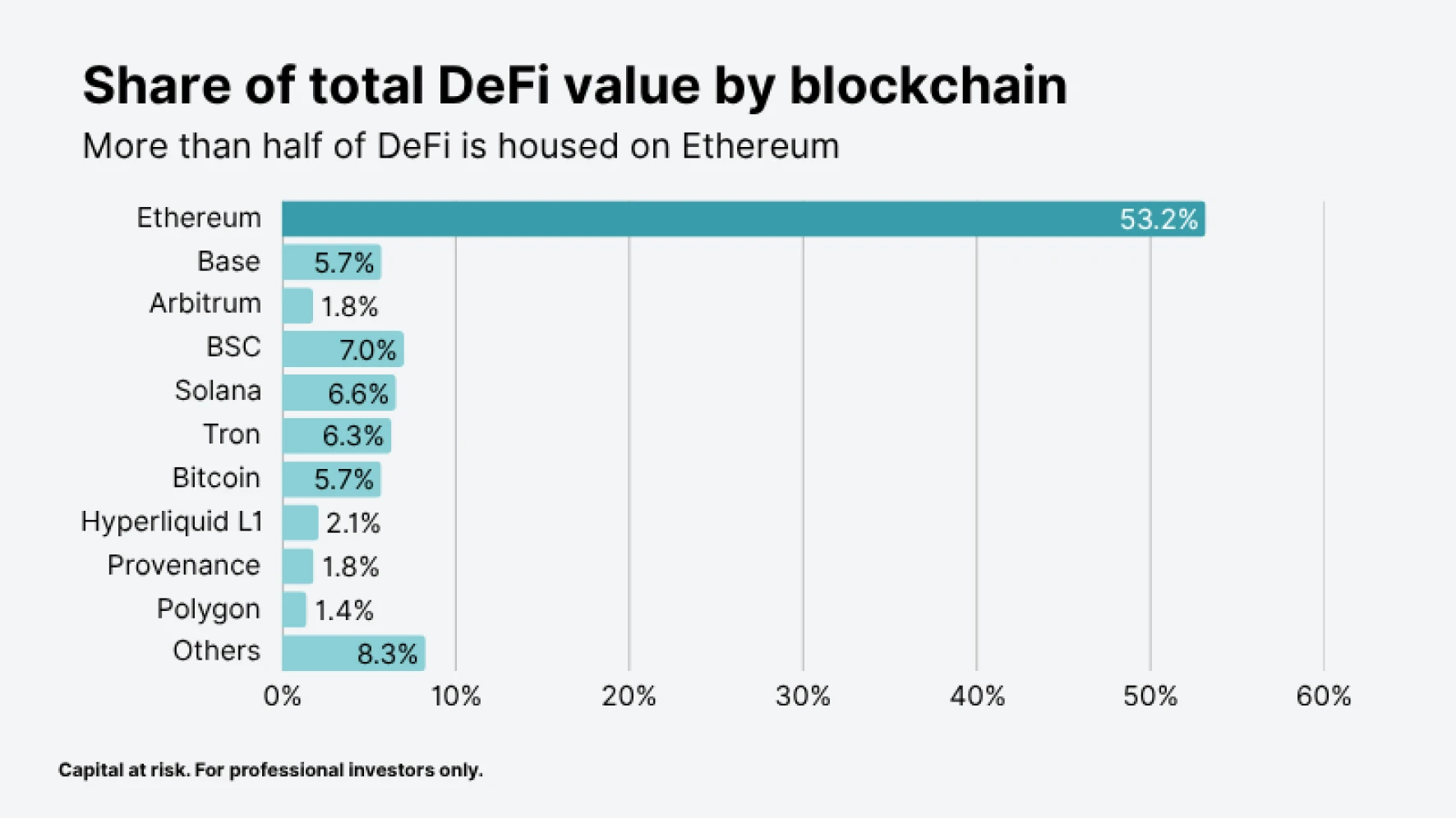
Data sourced from DeFiLlama on 18 June 2026.
Reason 3: Many Ethereum "competitors" actually run on… Ethereum
Blockchains like Base and Arbitrum look like Ethereum's rivals, but they're actually built on top of it. They're "Layer 2s" – faster, cheaper networks that run on Ethereum (the "Layer 1") and rely on it for security.
Base and Arbitrum together hold more DeFi value than any rival chain. Counted together, Ethereum and its Layer 2s run around 60% of all DeFi. Solana and Avalanche are single chains carrying everything themselves. Ethereum spreads the load while staying the secure base.
Layer 2s might take some network traffic away from Ethereum, but most still pay their fees in ether (ETH). Ethereum may earn less per transaction, but there are more transactions to earn from. So, many of Ethereum's "competitors" are more like its wholesale customers.
Every tokenized asset on Ethereum – or its Layer 2s – could add to future demand for ether (ETH). That's because most transactions on the network are paid for in ETH.
Leverage Shares offers 3X long and short Ethereum ETPs. Capital at risk
Key takeaways
Most tokenized assets already run on Ethereum, including BlackRock's BUIDL, the largest tokenized Treasury fund.
Ethereum currently leads on three fronts that tokenization needs: security, DeFi dominance, and a Layer 2 design that scales without giving up that security.
Layer 2 growth could support demand for ether (ETH) rather than drain it. But Ethereum's lead may narrow, so the long-term case isn't guaranteed.
Footnotes:
1Tokenized real-world asset market, ~$33bn, RWA.xyz, June 2026.
2Citi Institute, Tokenization 2030: Wall Street On-Chain, June 2026. Base case $5.5tn by 2030.
3US ETF assets under management, $15.7tn, FactSet, 31 May 2026.
4BlackRock USD Institutional Digital Liquidity Fund (BUIDL), launched on Ethereum via Securitize, March 2024. Around $2.5bn AUM, the largest tokenized Treasury fund as of mid-2026.
5JPMorgan tokenized money market fund on Ethereum, December 2025. Fidelity Digital Interest Token (FDIT) on Ethereum, late 2025.
6Ethereum validator count, beaconcha.in, June 2026.
7Solana validator count, validators.app, June 2026.
8Solana network outages, 2021–2023. Ethereum mainnet has had no comparable base-layer outage.
9Chain TVL ranking, DeFiLlama, as of 18 June 2026.