Bitcoin Breaks Below $60,000: Buy the Dip or Stay Away?
Bitcoin has spent much of the last decade defying sceptics, recovering from multiple bear markets and rewarding investors willing to endure volatility. However, the world's largest cryptocurrency is once again facing a critical test.
After reaching an all-time high of $126,110 in October 2025, Bitcoin has fallen more than 52%, briefly breaking below the psychologically important $60,000 level last week. The move pushed prices to their lowest levels since October 2024 and reignited a debate that has followed every major Bitcoin correction: is this simply another buying opportunity, or further weakness is likely to follow?
The answer may depend less on Bitcoin itself and more on where investors are choosing to allocate capital.
Crypto Is Losing the Capital Allocation Battle
Crypto continues to lose momentum, and fund flows show the largest crypto outflows since November. At the same time, money-market funds, bonds and equities all attracted fresh capital. But Bitcoin’s recent weakness may be about more than ETF outflows, geopolitical uncertainty or Strategy’s symbolic sale.
For years, Bitcoin benefited from a lack of compelling alternatives. Investors seeking inflation protection, growth exposure or disruptive technology often ended up in the same trade. Today, that advantage appears to be fading as capital has more destinations.
Part of the challenge is competition. Bitcoin is facing competition from other expressions of the same themes it once dominated. Investors looking for inflation hedges can buy gold, energy producers or commodity-linked assets. Investors seeking growth can buy AI companies generating real revenues and earnings. Even investors wanting exposure to digital assets have alternatives through exchanges, stablecoin businesses, tokenization platforms and blockchain infrastructure providers.
Consequently, crypto lacks a dominant market narrative just as investors are finding compelling opportunities elsewhere.
That helps explain why Bitcoin continues to diverge from technology stocks despite the resurgence in risk appetite. As AI-driven equities continue to reach new highs, investors are being forced to choose between scarce digital assets and businesses generating real cash flows today. Continued ETF outflows suggest capital is becoming more selective rather than simply rotating into risk.
That competition for capital may be one of the most underappreciated reasons behind Bitcoin's recent weakness.
ETF Outflows Are Sending a Warning Signal
Institutional demand was one of Bitcoin's biggest success stories during the 2024 and 2025 bull market. Spot Bitcoin ETFs opened the asset class to pension funds, wealth managers and traditional investors who previously avoided crypto. Now those flows are moving in the opposite direction.
Bitcoin ETFs recently experienced their longest streak of outflows on record, with billions of dollars leaving the sector over a matter of weeks. More concerning is that investors failed to aggressively buy the dip when Bitcoin returned to the $60,000 level.
Historically, sharp corrections have often attracted fresh demand. This time, institutional investors appear more cautious. That does not necessarily mean the bull market is over, but it does suggest investors are becoming selective about where they deploy capital.
Bitcoin's Identity Crisis
Perhaps the biggest challenge facing Bitcoin is that some of its most powerful investment theses are being questioned simultaneously.
The first is the "digital gold" argument. The war in Iran and the closure of the Strait of Hormuz created precisely the type of uncertainty that Bitcoin supporters have historically argued should benefit the asset. Instead, Bitcoin sold off.
The second investment thesis under scrutiny is Bitcoin's relationship with technology stocks. For much of the past two years, Bitcoin traded like a high-beta technology asset. However, while the Nasdaq and major AI beneficiaries continue pushing higher, Bitcoin has struggled to participate.
When an asset underperforms in both risk-off and risk-on environments, investors naturally begin questioning its role in a portfolio.
Bitcoin’s Fate Depends on the $60,000 Key Support
From a technical perspective, Bitcoin now sits at one of the most important levels of the current cycle. The $60,240 level has emerged as a critical support zone. Bulls will argue that Bitcoin successfully defended this area despite briefly breaking below it, suggesting buyers remain active.
If support holds, a recovery toward $76,000 becomes likely. Such a move would likely be supported by improving ETF flows, stabilising macro conditions and renewed institutional interest.
However, a decisive break below support could expose significantly lower levels and the $49,000 area would become the next major downside target if selling pressure accelerates. Therefore, the battle around $60,000 may ultimately determine Bitcoin's direction for the remainder of 2026.
Nevertheless, regardless of whether Bitcoin bounces from current levels or breaks lower in the near term, we believe a major bottom will be established this year, setting the stage for a new multi-year bull market. October remains our preferred timeframe for a significant inflection point, with the potential for a sharp reversal and the start of the next major uptrend.
Historically, major Bitcoin bottoms have coincided with bullish divergences between the price and the Relative Strength Index (RSI) indicator on the weekly chart. Such bullish divergence is currently developing, indicating that Bitcoin is approaching/or is at a major turning point. Although further downside remains possible, any additional weakness is likely to mark the final leg of the current downtrend before the next major bull trend begins.
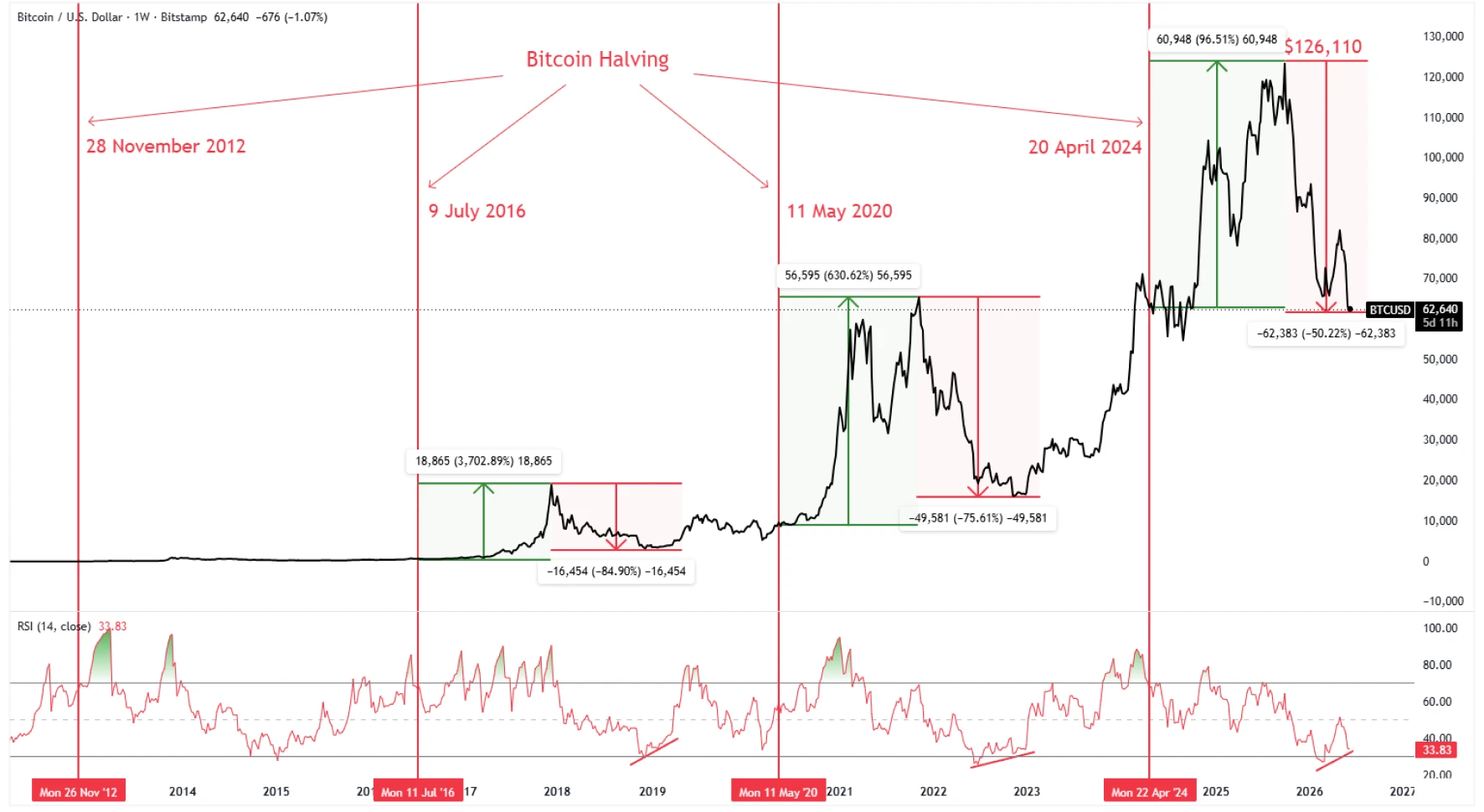
Source: TradingView. Bitcoin weekly price chart as of 9 June 2026.
Why Ethereum Is Lagging Bitcoin
While Bitcoin's decline has attracted most headlines, Ethereum's performance has been even more concerning. The second-largest cryptocurrency recently fell below its key support level of $1,755 and remains roughly 66% below its August 2025 peak of $4,955.
Historically, Ethereum has often outperformed Bitcoin during strong bull markets as investors become comfortable taking on additional risk. The opposite tends to occur during periods of corrections, and the current cycle appears to be following that pattern.
Ethereum's relative weakness is a reflection of the current macroeconomic environment rather than a deterioration in its long-term fundamentals. The prolonged war in Iran, higher oil prices, and renewed inflation concerns have increased expectations that the Federal Reserve may keep interest rates elevated for longer. In this environment, investors have become more defensive, reducing exposure to non-yielding, high-beta speculative assets like Ethereum, whose performance is more closely tied to liquidity conditions and broader growth expectations.
The divergence is also evident in institutional positioning. Spot Ethereum ETFs have experienced sustained outflows, while Bitcoin continues to attract the lion's share of institutional interest. This suggests that when investors allocate to crypto, they are currently favouring Bitcoin's simpler investment thesis over Ethereum's more complex proposition as a smart-contract and decentralised application platform.
What's particularly striking is that Ethereum's price weakness has occurred despite continued progress at the network level. Development activity remains robust, Layer-2 adoption continues to grow, and Ethereum remains the dominant platform for decentralised finance and tokenised assets. However, the strong fundamentals are being overshadowed by macroeconomic concerns, weak ETF flows, and a persistent deterioration in the ETH/BTC ratio.
Ethereum Remains the Backbone of the Digital Economy
The recent weakness in Ethereum prices should not overshadow its long-term importance. Unlike Bitcoin, Ethereum functions as the infrastructure layer for the growing digital economy. It powers decentralised applications, tokenised assets, digital identity solutions, stablecoins and much of the broader blockchain ecosystem. The network continues to evolve through scaling upgrades and Layer-2 adoption, while its proof-of-stake architecture has improved efficiency and altered the supply characteristics of ETH.
In many ways, Ethereum resembles a technology platform more than a monetary asset. The challenge is that technology platforms often struggle during periods when liquidity tightens and investors become more risk-averse. That appears to be exactly what is happening today.
Extreme Fear Often Creates Opportunity
Fear levels across the market have reached some of their lowest readings in years, while liquidations, ETF outflows and negative headlines continue to dominate investor conversations. However, periods of extreme pessimism have often created the foundations for future recoveries.
That does not mean prices cannot fall further. Markets frequently remain irrational longer than investors expect. Yet some of crypto's reversals have occurred when sentiment appeared overwhelmingly negative.
If Bitcoin and Ethereum can defend their support levels and ETF flows stabilise, the recent correction may ultimately be remembered as another opportunity disguised as a crisis. If not, investors may need to prepare for a deeper and more prolonged crypto winter. For now, the battle between fear and conviction continues.