The consumer price index (CPI) is the monthly US inflation report. US inflation rose from 2.4% in February 2026 to 4.2% in May, before falling back to 3.7% in September. The US Federal Reserve (Fed) raised interest rates in September – its first hike since 2023. So we tested how bitcoin reacted to every CPI report since January 2016 (129 in total). Most of the time, bitcoin moved about as much on CPI day as on any other day. The exceptions came when inflation was above 4%.
5 of 129 CPI days had bitcoin's biggest price swing that month
A price swing is the difference between bitcoin’s high and low on a given day. Over 129 months, CPI day had the month’s biggest price swing just five times. That’s about as often as any other day of the month.
We started in January 2016 to cover more than ten years of CPI reports. Before then, bitcoin was a much smaller market, and fewer investors traded it on economic news like inflation. Going back further would also add more “low-inflation” years, because US inflation stayed below 4% from 2009 to early 2021.
To compare like with like, we measured each CPI day (orange) against other weekdays (blue) in the same month. The chart below shows the average swing for both, across four periods since 2016.
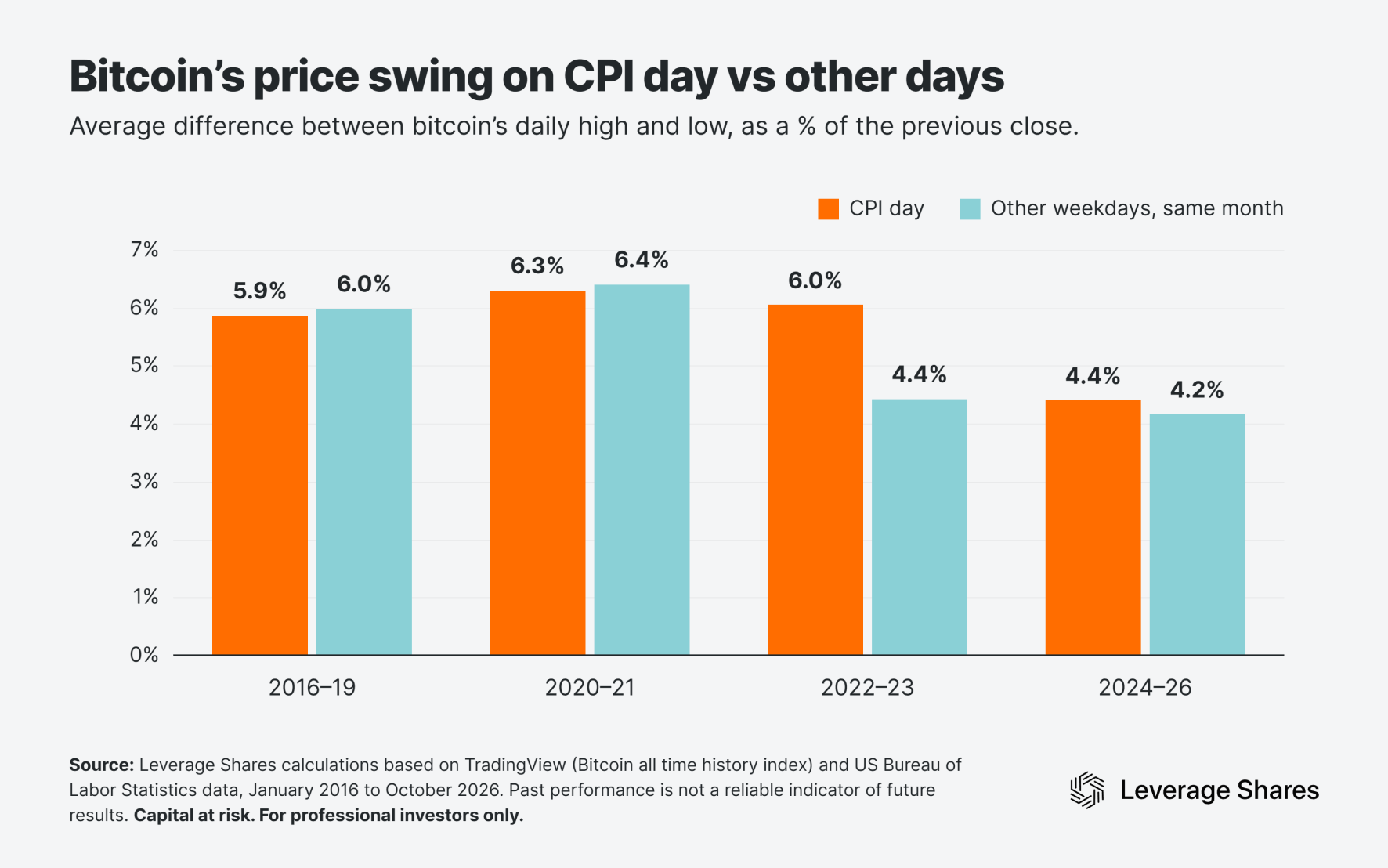
As you can see, there’s not much difference, except in 2022-23. Inflation peaked at 9.1% in that time, and bitcoin’s CPI-day swing averaged 6.0% against 4.4% on other weekdays.
Bitcoin reacted to CPI when inflation was above 4%
When US inflation was above 4%, a higher-than-forecast CPI report tended to push bitcoin lower. The forecast is the average estimate from economists, published before each report.
We drew the line at 4% – twice the Fed’s 2% inflation target. Inflation was above that line in 26 of the 129 reports (mostly between May 2021 and May 2023). In 14 of those, it was higher than forecast – and bitcoin fell on nine of those days. Bitcoin’s biggest CPI-day drop of 2022 came on 13 September. Inflation was 8.3% against a forecast of 8.1%, and bitcoin fell 10% that day.
But when inflation was at 4% or below, the forecast made no real difference. Bitcoin fell on 17 of the 30 days inflation was higher than forecast – close to a coin flip.
The chart below shows every CPI report as a dot. It splits them into reports with inflation at 4% or below (blue) and above 4% (orange). In each panel, the further right a dot is, the higher inflation was against the forecast. And the higher the dot, the better bitcoin did that day.
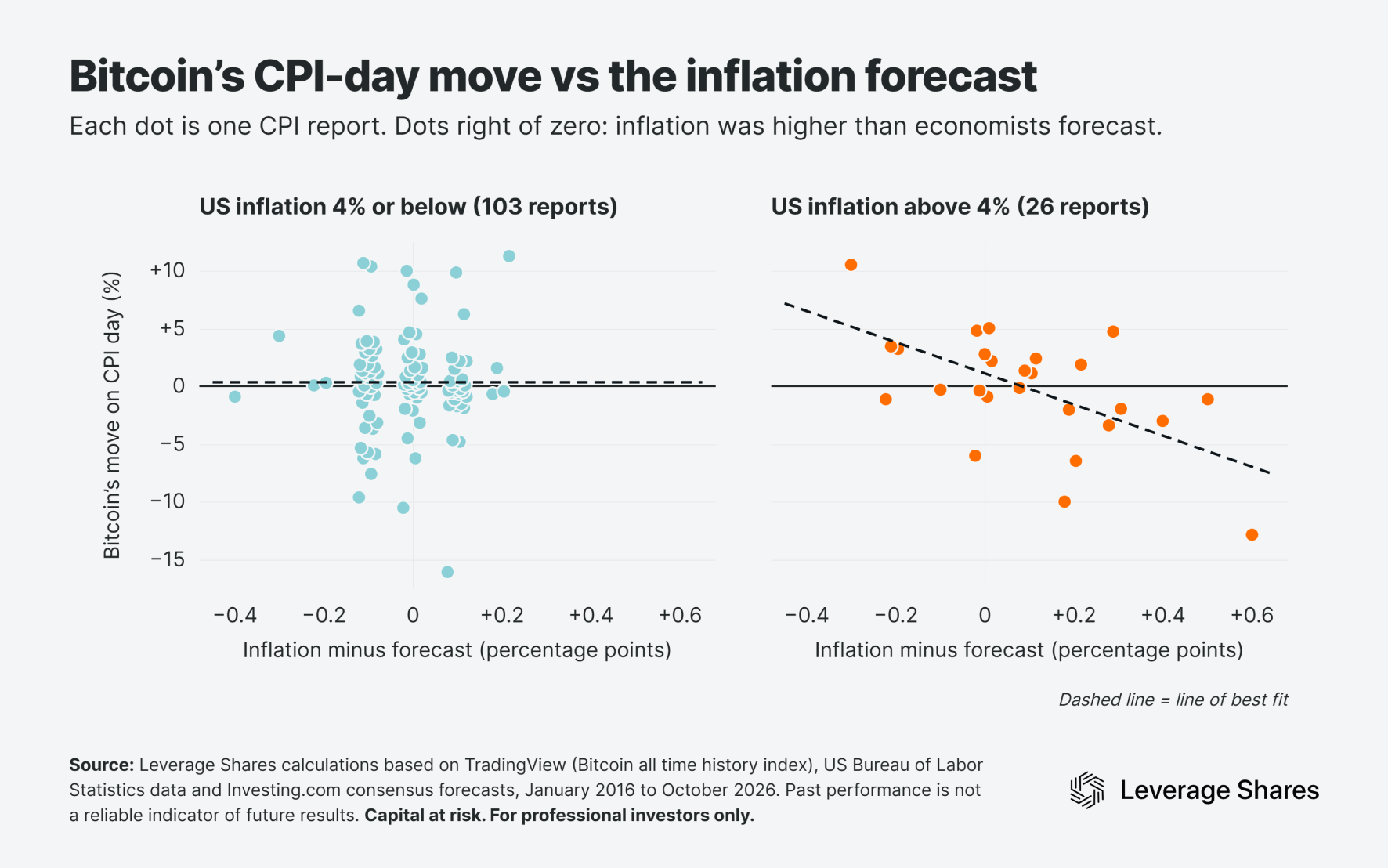
Notice how the dots above 4% (orange) drift lower as you move right, following the dashed line. The higher inflation was against the forecast, the worse bitcoin tended to do that day. The dots at 4% or below (blue) form a flat cloud, so the dashed line through them stays flat. In other words, with inflation at 4% or below, the forecast had no clear impact on bitcoin’s move that day.
When inflation was above 4%, bitcoin's falls on CPI day usually lasted the week
Bitcoin fell on 14 CPI days while inflation was above 4%. It kept falling over the next seven days in 11 of them. The typical move was a 2% drop on CPI day, then another 3% over the following week.
But with inflation at 4% or below, bitcoin usually bounced back instead. It kept falling after only 13 of its 44 drops, and rose 3% over the next week on average.
The chart below turns those numbers into percentages. With inflation above 4%, bitcoin’s CPI-day drops kept going 79% of the time (left bar). With inflation at 4% or below, they kept going just 30% of the time (right bar). And after an ordinary down day with no CPI report, the figure was 46% (middle bar). So when inflation was high, CPI-day drops kept going far more often than normal.
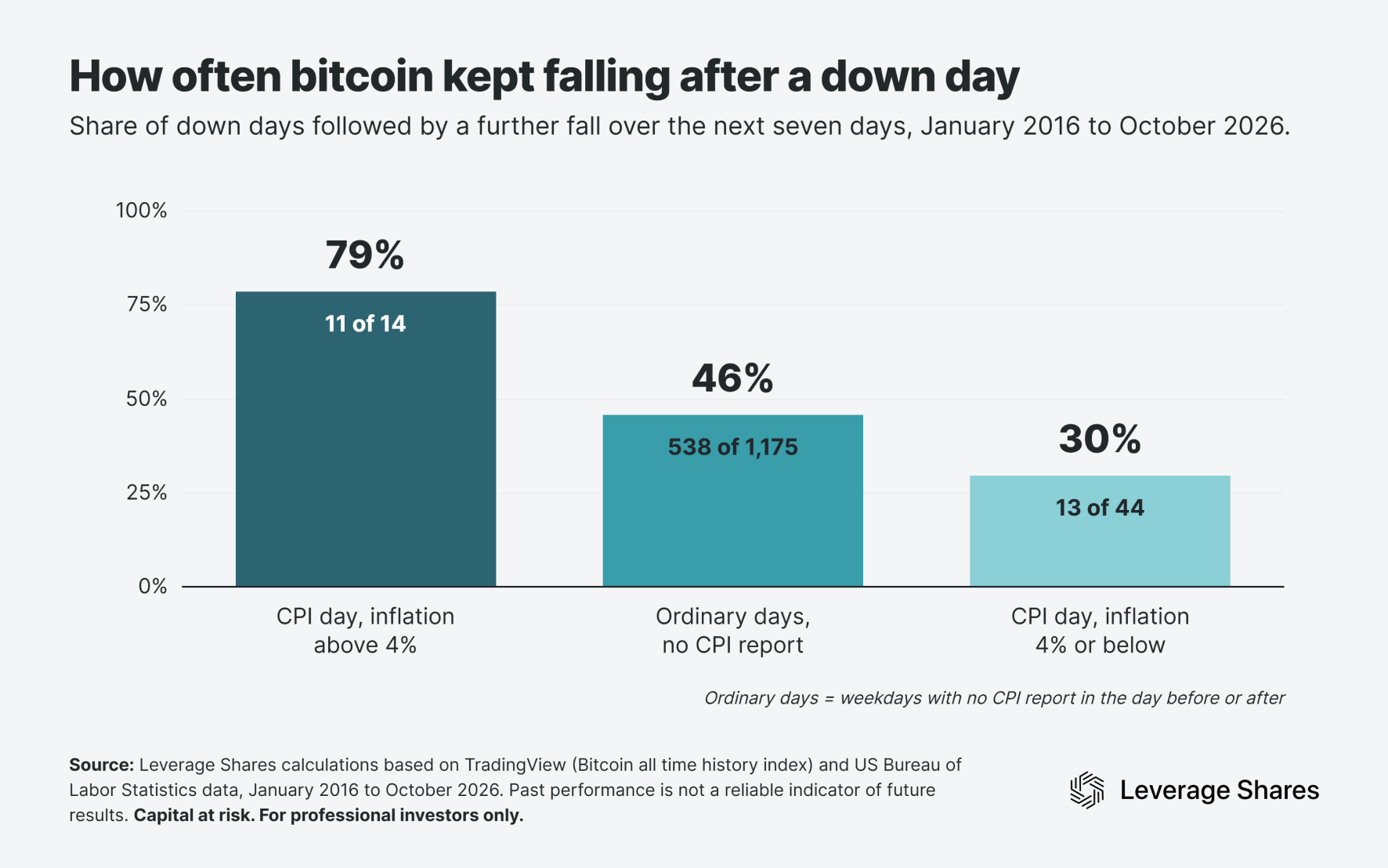
Just keep in mind that 14 falls is a small sample, so it’s no guarantee of what happens next.
Leveraged exchange-traded products (ETPs) reset daily, so every day of a falling week counts. When a fall lasts several days, a 3x short ETP's daily gains can compound on a growing base. A 3x long ETP would lose on each of those down days.
Leverage Shares offers 3x Long and Short Bitcoin ETPs, which aim to provide three times the daily move in bitcoin, before fees. Capital at risk.
Key takeaways
- Across 129 US CPI reports since 2016, CPI day was usually just another day for bitcoin. It had the month's biggest price swing just five times.
- When US inflation was above 4%, a higher-than-forecast CPI report tended to push bitcoin lower on the day.
- In that period, bitcoin kept falling over the next week after 11 of its 14 drops on CPI day. Past performance is not a reliable indicator of future results.