The 30-year US Treasury yield hit 5.73% on 8 October – its highest level since 2002. It’s since fallen to around 5.3%, while bitcoin is still trading near $80,000. We tested how bitcoin reacted to US bond yields each month since January 2020. Bitcoin has behaved like a long duration asset, but rising inflation expectations have had a stronger link to it.
What's a long duration asset?
A long duration asset gets most of its value from a payoff far in the future – not from what it pays out today. Long-dated bonds and fast-growing tech stocks are good examples of this.
Long-dated bonds pay interest (coupons) far into the future – say, for 20 or 30 years. Plus, the principal (the initial loan value of the bond) is only due back to the investor at the final maturity date. So most of the value you get from a 30-year bond arrives more than a decade from now.
Tech companies invest heavily in growing their businesses today, and many trade at high prices compared with what they earn now. So investors often buy them for the profits they might make tomorrow – not what they earn today.
Long duration assets tend to move the most when interest rates change – up or down. That’s because every investment has an “opportunity cost” versus earning the interest rate. The higher that interest rate, the bigger the opportunity cost of holding an investment (and vice versa). And the longer you wait for the payoff, the more interest you give up. So when rates rise, investors tend to pay less for long duration assets – and more when rates fall.
As you can see, there’s not much difference, except in 2022-23. Inflation peaked at 9.1% in that time, and bitcoin’s CPI-day swing averaged 6.0% against 4.4% on other weekdays.
Why bitcoin is a long duration asset
Bitcoin pays no income, so its value today depends on what investors think it could be worth tomorrow. There are no coupons or profits to collect along the way – all of the payoff is in the future. So bitcoin tends to be sensitive to interest rates too.
In 2020, for example, the US Federal Reserve (Fed) cut interest rates to near zero, and bitcoin rose 304%. In 2022, it raised them to over 4%, and bitcoin fell 64% (with the Terra and FTX collapses on top). Long-dated Treasuries and the Nasdaq fell about half as much that year (31% and 33%, respectively).
Bitcoin and bond yields: here's what we found
A US Treasury yield is the interest you earn each year for lending to the US government, as a percentage of the current bond price. Right now, a 10-year US Treasury bond pays about 5.0% per year, which roughly splits into two parts:
- The real yield (about 2.6%): the yield on 10-year Treasury bonds that are protected against inflation. So it’s the interest rate that’s left after inflation. It’s what you give up each year, after inflation, by holding something that pays no income, like bitcoin.
- Inflation expectations (about 2.4%): the difference between the normal 10-year yield and the real yield. It shows the average yearly inflation rate bond investors expect over the next 10 years. When inflation expectations rise, investors expect money to lose value faster.
These two parts can move in opposite directions, even when the 10-year yield barely moves. So we tested every month from January 2020 to September 2026 (81 in total). Each month went into one of four groups, based on how the real yield and inflation expectations moved that month:
- Cheap money: real yield down, inflation expectations up.
- Growth worries: real yield down, inflation expectations flat or down.
- Strong economy: real yield up, inflation expectations up.
- Tight money: real yield up, inflation expectations flat or down.
The chart below shows how often bitcoin rose in each group.
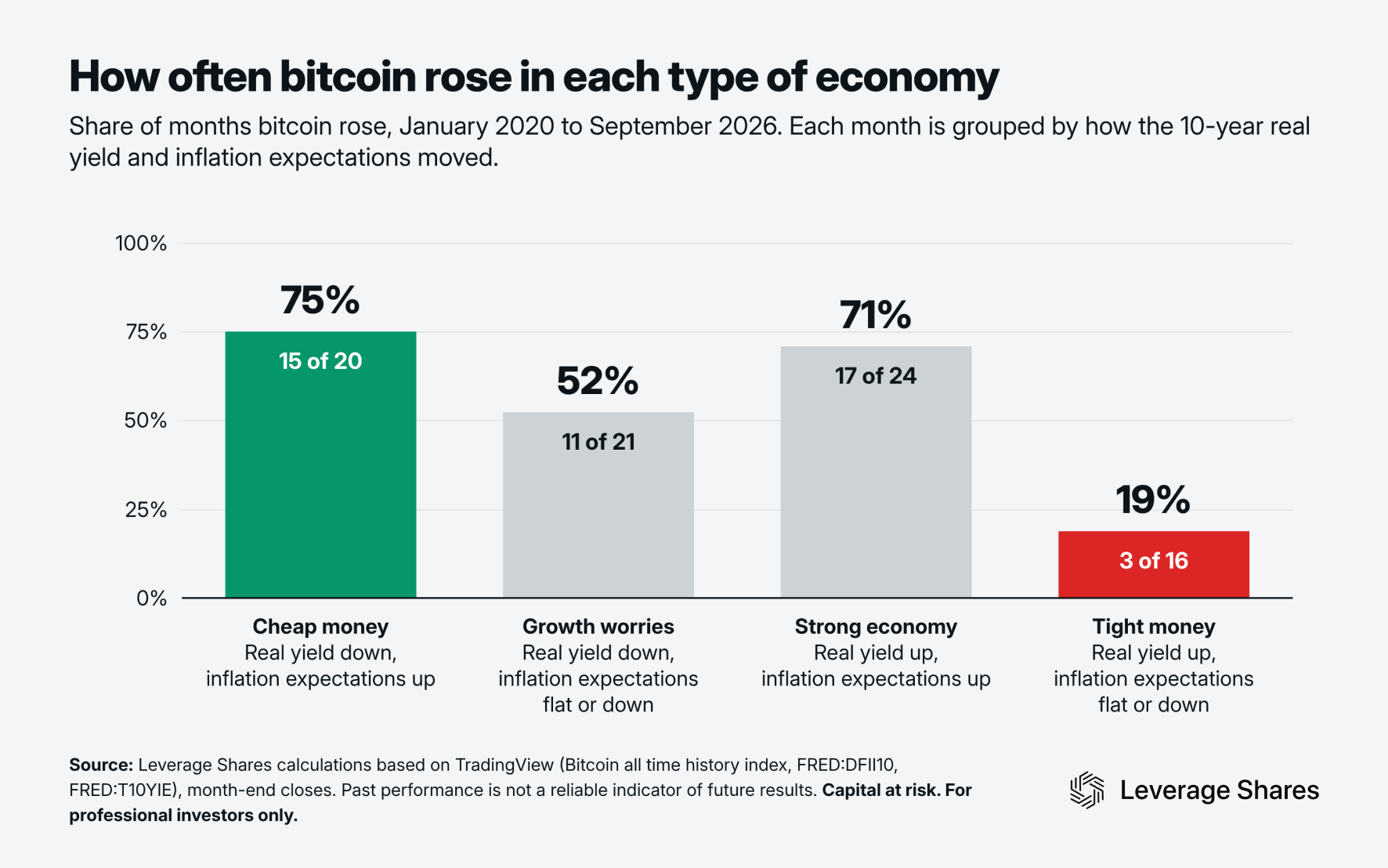
As you can see, bitcoin did best with cheap money (green) – it rose in 15 of those 20 months. But it rose in just 3 of 16 tight-money months (red).
So is bitcoin a long duration asset or an inflation hedge?
Bitcoin has behaved like a long duration asset. It rose in 63% of the months when the real yield fell, against 50% when it rose. So falling real yields have tended to help bitcoin.
But inflation expectations had the stronger link. Bitcoin rose in 73% of the months when inflation expectations climbed, against 38% when inflation expectations were flat or down.
Bitcoin isn’t a simple inflation hedge, though. US inflation hit 9.1% in 2022, but inflation expectations fell from April as the Fed raised rates. And bitcoin fell with them. So, it’s tended to move with expected inflation, rather than actual inflation.
Just keep in mind that these are links, not proof that one thing causes another. And under seven years of data is no guarantee of what happens next.
Leverage Shares offers 3x long and short Bitcoin ETPs, which aim to provide three times the daily move in bitcoin, or three times the inverse, before fees. Capital at risk.
Key takeaways
- A long duration asset gets most of its value from a payoff far in the future. So it tends to move the most when interest rates change.
- Bitcoin pays no income, so all of its payoff is in the future. As a result, it tends to be sensitive to interest rates.
- Since 2020, bitcoin rose in 15 of 20 cheap-money months and just 3 of 16 tight-money months. But inflation expectations have had a stronger link to bitcoin than real yields.