From October Euphoria to November Panic
Two months ago, Bitcoin was testing fresh highs near $126,000. By the 21st of November, it had plunged to $80,840, erasing its year-to-date gains and igniting fears of a looming crypto winter. The drawdown accelerated a wave of forced liquidations, collapsing sentiment and producing the largest ETF outflows since these products launched almost two years ago.
This selloff unfolded alongside a broad deterioration in global risk appetite. Technology stocks weakened, bond yields climbed, hedging demand rose, and volatility picked up across asset classes. Bitcoin, historically one of the fastest indicators of risk sentiment, reacted first and most sharply.
ETF Outflows Surged and Sentiment Soured
Bitcoin ETFs, which fuelled much of the 2025 rally, suddenly became a source of selling pressure. Bitcoin dropped 35% from its October high dragging it below the average entry price for US spot ETF buyers, estimated around $89,600. That left much of this year’s inflows in the red. Approximately $2.8 billion exited ETFs in November, while the wider crypto market shed around $1 trillion in value in October. The ETF outflows showed weakening conviction among new institutional and retail buyers and was exacerbated by thin liquidity, algorithmic selling, and systematic strategies that sold into weakness. Taken together, these pressures amplified the downside momentum and sentiment took a hit.
Bitcoin Plunged Amid Collapsed Fed Cut Expectations
While technical factors contributed to the decline, the macro backdrop was the primary catalyst behind the selloff. Earlier in the year, Bitcoin rallied on expectations of multiple Federal Reserve rate cuts. Those expectations deteriorated dramatically through October and November. The prolonged US government shutdown froze key economic data releases, injecting uncertainty and forcing the Fed into a more cautious stance. This sharply reduced the perceived likelihood of a December rate cut.
Tighter liquidity always hits high-beta assets first. Bitcoin, acting as a global liquidity barometer, absorbed the impact immediately. Volatility rose across both Nasdaq and crypto markets, yet the VIX only drifted modestly higher. This suggested orderly de-risking rather than panic. Markets had been methodically hedging for months, setting the stage for a position-clearing episode rather than a structural breakdown.
Why The Selloff Still Doesn’t Look Like a Crypto Winter
Despite the dramatic drawdown, several characteristics suggest that this downturn is not the beginning of a multi-year crypto winter. Previous crypto winters began with euphoric, speculative peaks, something absent in this cycle. This correction appears driven by macro uncertainty rather than structural damage within the digital-asset ecosystem.
On-chain data shows the selling pressure has come primarily from short-term holders, while long-term conviction investors continue to accumulate. Importantly, there have been no major institutional collapses or credit events, unlike the FTX-driven contagion in 2022. Mid-cycle drawdowns of 25 to 30% are historically normal for Bitcoin and have occurred in nearly every bullish phase.
Bitcoin cycles often include a flush-out month, where leveraged long positions unwind violently and sentiment turns negative. Although unpleasant, these events often set the stage for the next leg higher. The current downturn aligns with that pattern rather than with the onset of a broader bear market.
Dovish Fed Outlook Sparks Optimism for Bitcoin
Expectations for a Federal Reserve rate cut in December surged in early December, and traders now assign close to 90% probability of a 25-basis-point cut at the December 9-10 meeting, compared with around 40% only a few weeks earlier. Softer labour data, easing inflation pressures, dovish commentary from policymakers, and the absence of pushback from Fed Chair Jerome Powell bolstered this turnaround.
Betting markets also place high odds on Kevin Hassett becoming the next Fed Chair, raising expectations of a more dovish stance in 2026. This renewed confidence in monetary easing has helped improve risk sentiment and could restore liquidity conditions that would support high-beta assets, such as Bitcoin.
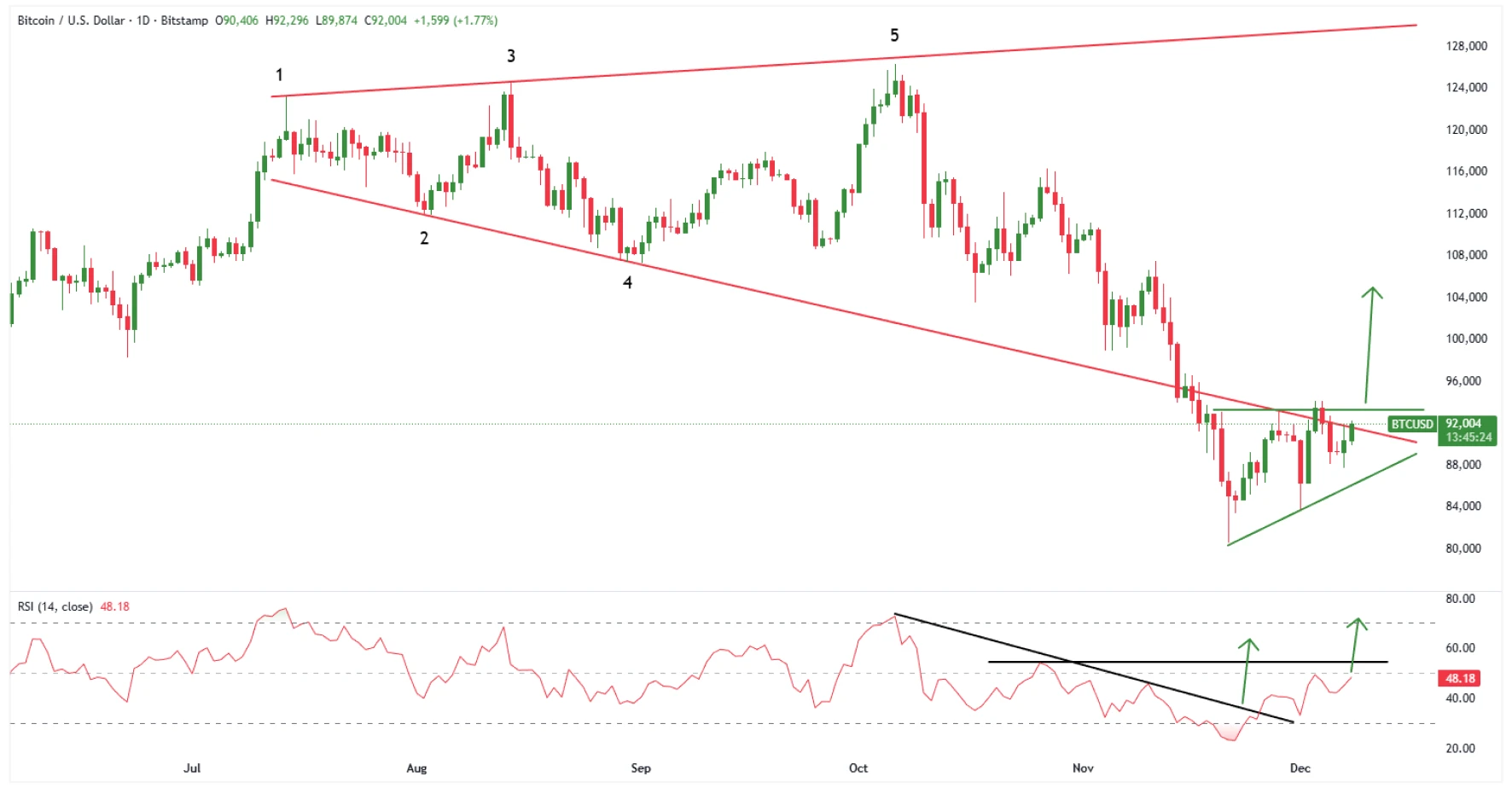
Source: TradingView. Bitcoin daily price chart as of 8 December 2025.
Technical Setup Points to a Rally Toward $105,000
Bitcoin reached strongly oversold momentum territory after its sharp decline to $80,840 in November, from which it has rebounded toward $94,000. The chart now shows two higher lows, forming the early structure of a small ascending triangle, a pattern that typically signals that buying support is rebuilding.
The down trend line on the leading Relative Strength Index (RSI) indicator has been broken, suggesting that a short-term rebound is likely to unfold. A break above minor resistance of $94,100 would be the first encouraging technical signal since the decline began. If that level is cleared decisively, the setup could support a short-term rally toward $105,000.
Bitcoin is heading into a historically supportive seasonal period. On-chain metrics and flow data show early signs of stabilization, with the recent disconnect between crypto and tech stocks appearing driven more by crypto-specific positioning unwinds than by a deterioration in global macro conditions.
Key Risks to Monitor in the Coming Weeks
Although the structure of the selloff looks more cyclical than structural, several risks warrant close attention. These include the possibility of a another correction in technology stocks, renewed ETF outflows, or further deterioration in liquidity.
On the other hand, a Fed rate cut next week, stabilization across global equities, improvement in ETF flows, and a potential break above $94,100 could underpin a recovery.
Key takeaways
Macro uncertainty and collapsing Fed cut expectations drove the bulk of Bitcoin’s November selloff.
ETF outflows and positioning unwind amplified volatility, but structural crypto fundamentals remain intact.
Improving rate-cut odds and encouraging technical signals point to potential upside toward $105,000.