Most investors know that Bitcoin has a hard cap of 21 million coins. But fewer understand how Ethereum’s supply works – and how the answer might affect the price of ETH. Unlike Bitcoin, Ethereum has no fixed supply cap: the network can create new coins and destroy them. That makes ETH potentially inflationary or deflationary depending on network activity.
Three changes to the network since 2021 control how new ETH enters circulation – and how existing ETH gets destroyed. This guide explains how the Ethereum supply works today.
Ethereum has no supply cap
Ethereum launched in July 2015 with about 72 million ETH. Under the original proof-of-work system, miners earned new coins for processing transactions. The coin supply grew quickly with no built-in limit.
The Bitcoin supply works differently. New BTC arrives at a set rate that halves roughly every four years. The total will never exceed 21 million. Ethereum has no set issuance speed or limit – it depends on protocol rules that developers can change through upgrades.
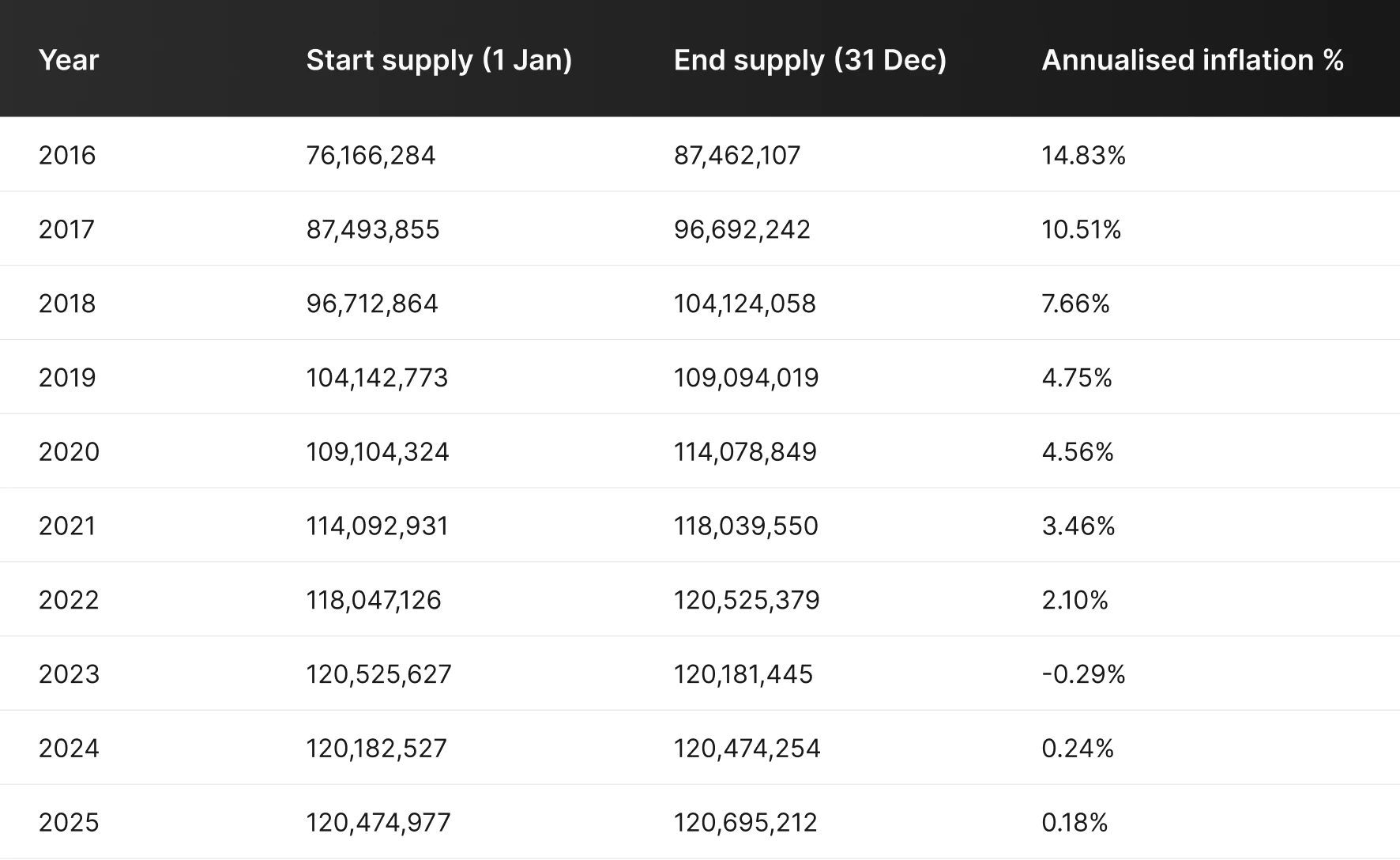
As of April 2026, roughly 120.7 million ETH are in circulation. The rate of supply growth has fallen dramatically over time. And in 2023, supply even shrunk.
The table below shows how the ETH supply has changed each year since 2016.
Data sourced from Etherscan on 17 April 2026
Two things stand out. First, annual inflation dropped from nearly 15% to under 1% in a decade. Second, 2023 was deflationary – meaning the total supply actually fell. ETH went from a high-inflation digital asset to one that hovers near zero net growth.
Three changes to the network since 2021 caused that shift. The next section explains each one.
Three upgrades that changed the Ethereum supply
Three upgrades have changed the rate at which Ethereum produces new ETH. Each one changed a different part of the system.
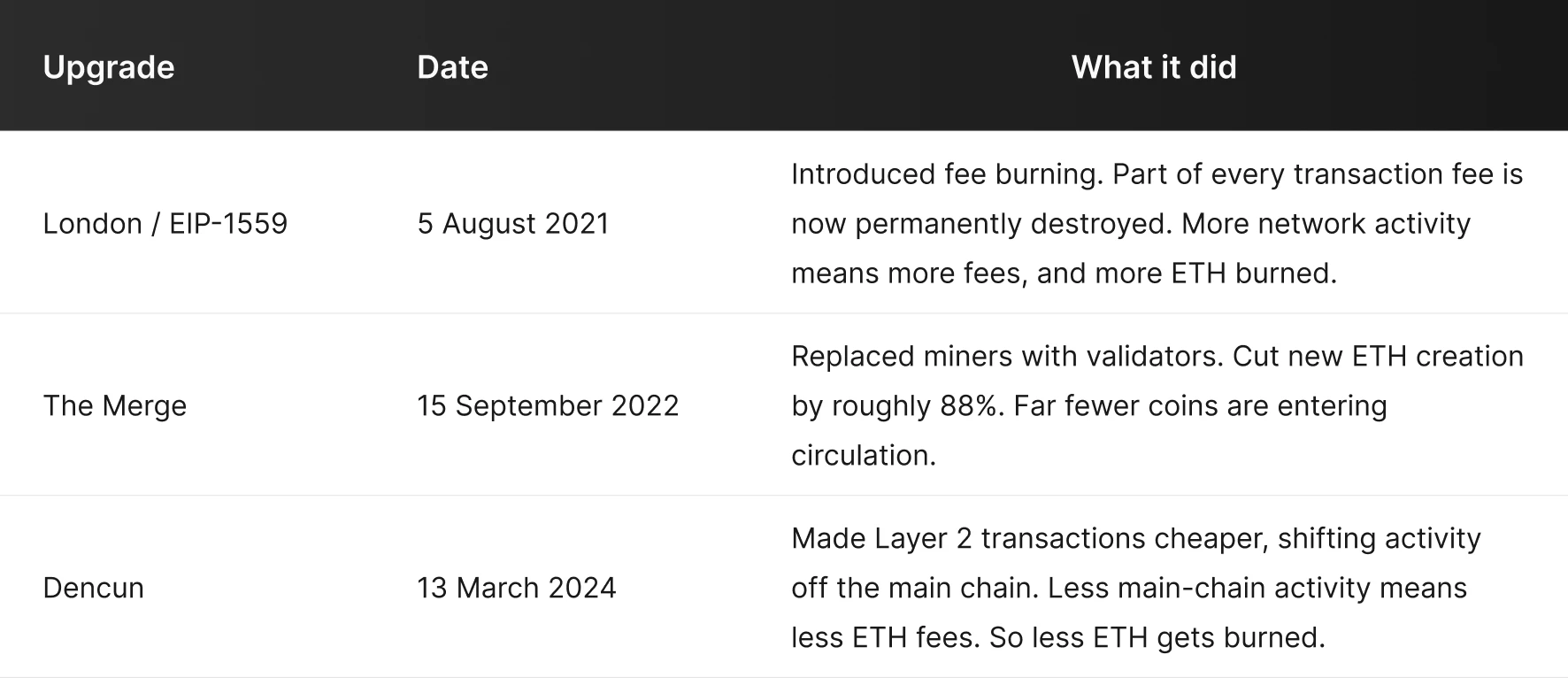
Before EIP-1559, every transaction fee went straight to miners. After EIP-1559, the network now burns a base fee and passes a small optional “tip” to the block producer. The busier the network, the more ETH gets destroyed.
The Merge was the biggest single change. It replaced energy-intensive mining with proof of stake – a system where coin holders secure the network instead of miners. Ethereum's own documentation puts the issuance reduction at roughly 88%. Combined with the burn, The Merge made it possible for the ETH supply to actually shrink during busy periods.
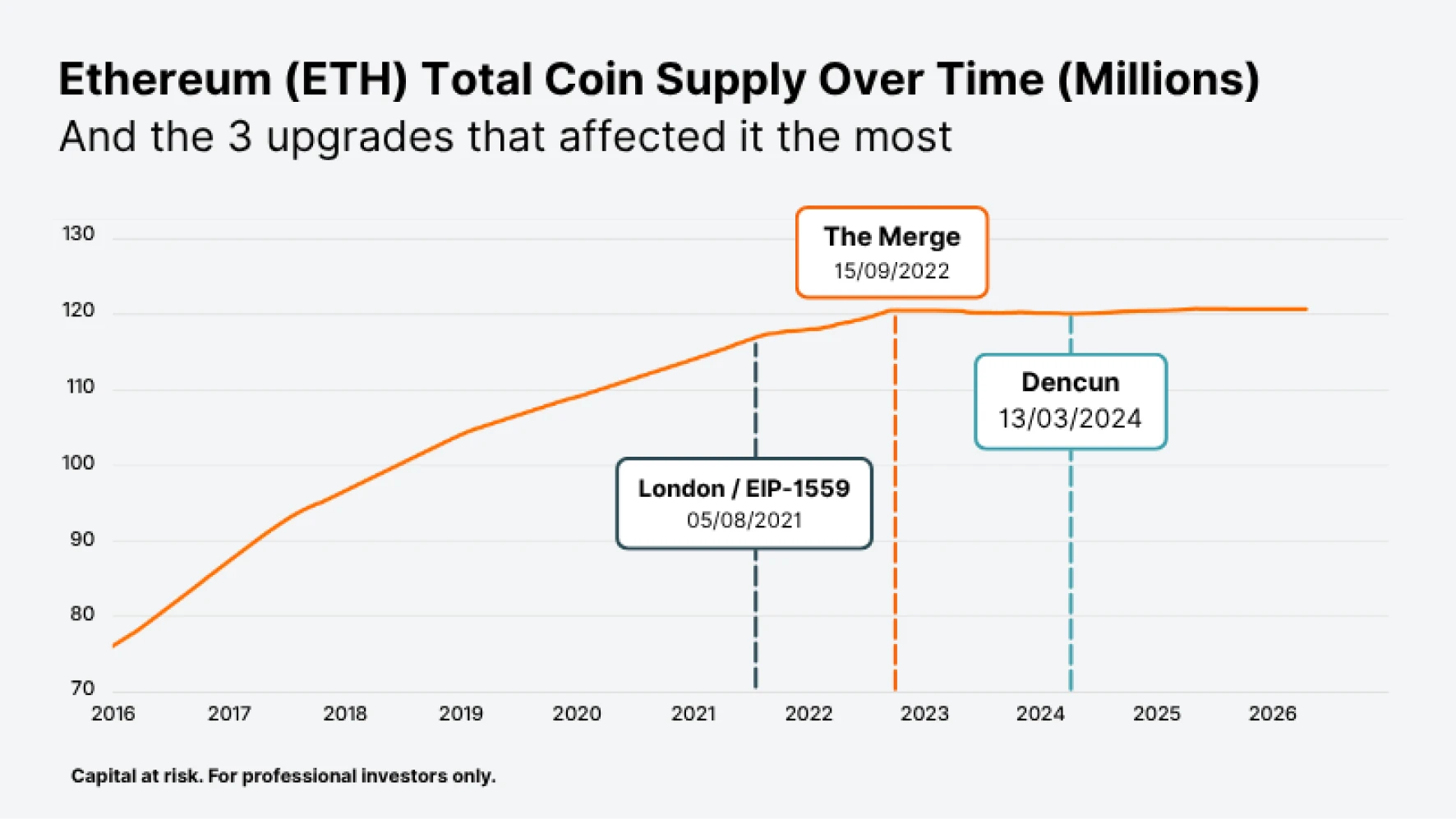
The chart below shows Ethereum's total coin supply over time. The curve climbs steeply until 2021, then flattens after the first two upgrades took effect.
Data sourced from Etherscan on 17 April 2026
Dencun’s impact on the ETH supply was less direct. It didn't change how many new coins the network creates. But Dencun made transactions cheaper on “Layer 2” networks – chains built on top of Ethereum that handle transactions off the main chain. That shifted activity away from Ethereum (the “Layer 1”). Since the fee burn only applies to Layer 1 fees, less activity there means less ETH gets destroyed.
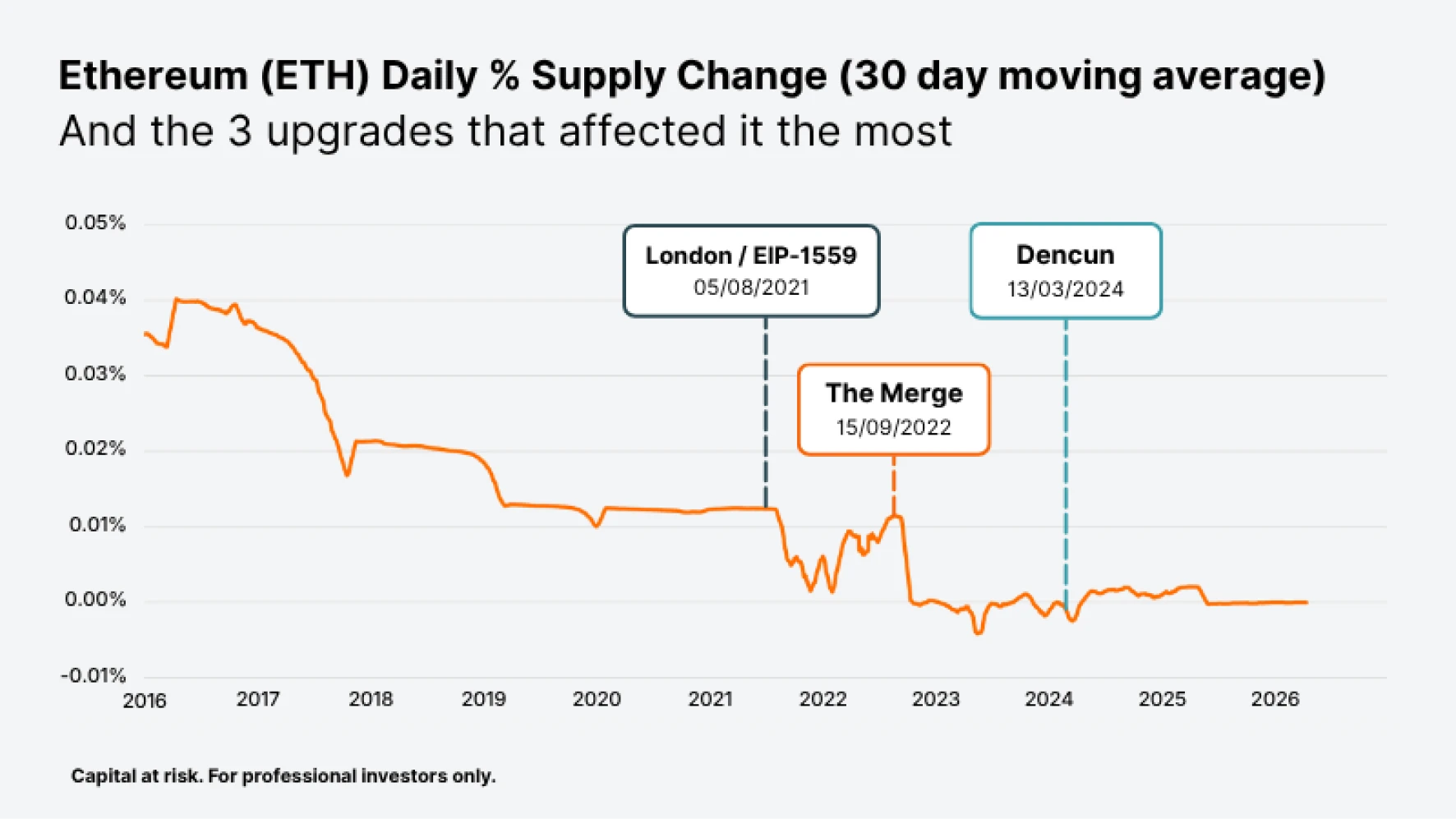
The chart below shows Ethereum's daily supply change as a 30-day moving average. The daily rate ran at roughly 0.04% before EIP-1559, crashed to below zero after the Merge, then drifted slightly positive again after Dencun.
Data sourced from Etherscan on 17 April 2026
What the Ethereum supply means for investors
ETH supply grew by just 0.18% in 2025. For context, the Bitcoin network currently creates 3.125 BTC per block after the April 2024 halving. That adds up to roughly 164,250 new BTC per year – an annual inflation rate of about 0.82%. So ETH now inflates at less than a quarter of that pace. And the amount of ETH actually available to buy is even scarcer than that number suggests.
As of early 2026, over 36 million ETH – roughly 30% of total supply – is locked in staking contracts. Validators commit these coins to secure the network and earn yield in return. That ETH isn't on exchanges. It’s not currently for sale.
Basic economics applies here. When supply is constrained and demand increases, prices may rise. When supply grows and demand drops, prices could fall. Ethereum's adaptive supply means both outcomes are possible depending on network activity and staking levels.
But for the way Ethereum works today, one thing holds true. The greater the network activity, the slower the supply grows. And at peak demand, it can even shrink.
Leverage Shares offers 3x long and 3x short Ethereum ETPs for traders who want amplified daily exposure to ETH price moves.
Key takeaways
ETH has no fixed supply cap. Roughly 120.7 million ETH exist today, but over 30% is locked in staking contracts and can't be traded.
Three upgrades changed how fast the Ethereum supply grows. EIP-1559 introduced fee burning, the Merge cut new issuance by roughly 88%, and Dencun shifted activity to cheaper layers.
A tighter available supply could amplify price moves in either direction. ETH supply adapts to network demand rather than following a fixed schedule.